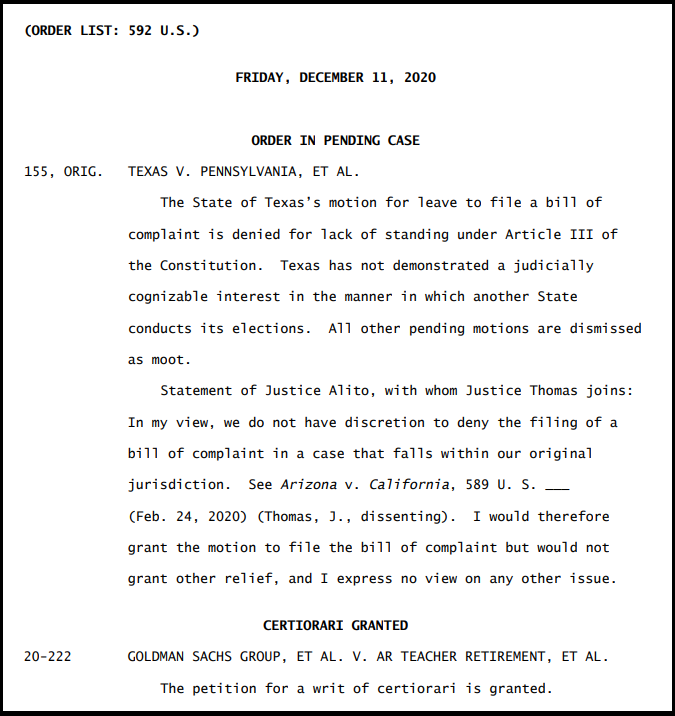
 In a disappointing majority decision announced shortly before 6:30pm Friday evening, a majority of Supreme Court justices refused to take up a Texas lawsuit challenging four states in the 2020 election.
The court, with two dissenting options by Justice Alito and Justice Thomas, stated that Texas lacked a legal right to sue and did not have a legal interest in how other states carried out their elections.
The court rejected the Texas’ lawsuit without considering the specific merits of the state’s case.
Texas had asked the court to delay the official vote of the Electoral College, scheduled for Monday, Dec. 14, or prevent the four states from casting votes in the Electoral College for Biden. Justice Alito filed a short statement regarding the court’s disposition of the case and was joined by Justice Clarence Thomas.
The position of the Supreme Court raises an important question that now sits unresolved. If an individual citizen is determined not to have standing to challenge an election result; and if a group of citizens represented by their interest in a state, any state, is also denied standing to challenge an election result; then who can constitutionally challenge an election, any election, that is mired in controversy and demonstrable evidence of fraud?
From the Alliance:

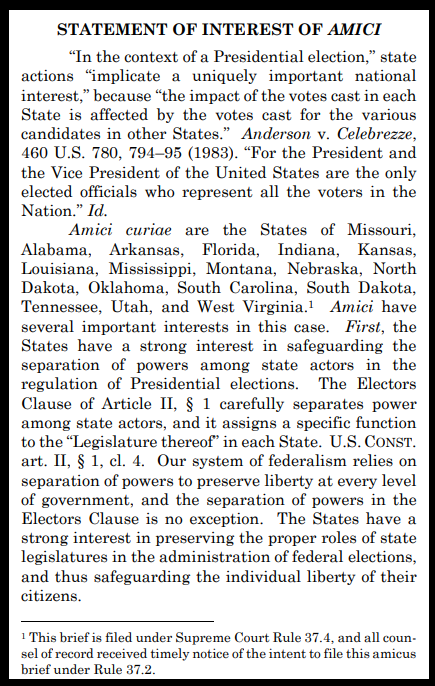 Today 17 states filed an amicus brief [
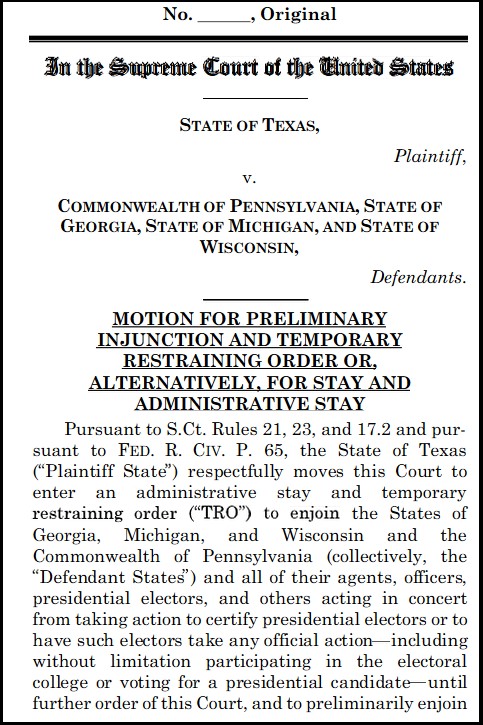 Texas Attorney General Ken Paxton has filed a lawsuit [