This MBOB has a word picture about January thaws, a true story from the 1950s and a book recommendation.
 It’s a Sunday afternoon in eastern Montana in the 1950s. It’s been bitterly cold for a long time, but the blizzard has finally moved on. The main roads have been plowed and things look like they might be settling back to normal for the season. While the temperature is still hovering around zero (F) every night, at least the everlasting wind has stopped.
When it’s dead quiet on the prairie after a storm and it’s really cold, everything crunches.
Every step crunches – sharply – boots squeaking against the surface of the tile-hard snow put in place by just slightly-less-than-hurricane-force winds, which then polished it smooth.
 A glance out the frosted kitchen window reveals diamonds spread as far as the eye can see. A million facets of frigid, glittering carats.
The triangle of frost on every pane of glass documents the escape of precious heat but we didn’t know that. We just knew Jack Frost had paid a visit and had left spectacularly detailed art for our viewing pleasure.
 By the time we were five or so, we knew not to touch the windows when Jack Frost had come, but just watch the kaleidoscopic beauty of each square of glass change over the hours. The frost was usually gone by evening and if we didn’t touch the window, it departed quietly and left clean glass behind. If we couldn’t resist and had touched the window there was a little fingerprint at every point of contact meaning that the windows had to be cleaned in the dead of the winter. Moms were happier if they didn’t have to do that job over and over again.
~~~~~~~~~~~~~~~~~~~~~~~~~~~
Having a fer-real January thaw meant that in the middle of such conditions there would be the gift of four or five days when the daily high temperature was between 35-40 degrees F. The sun shines. The hard edges of the packed snowdrifts soften and begin to droop under the warmth and after a couple of days, mud is being spattered from passing cars onto the still good-sized drifts. They begin to look dirty and not-so-wintry, kind of messy.
Along about this point in the process, someone will wish for a return of cooler weather so some bright white and brand new snow might fall and make things all pretty again.
In the northern latitudes winter does not regularly feature the slush and mud and ice storms that are frequently the bane of the folks in Missouri and Tennessee. It’s flat cold, frozen solid, serious winter, and pretty in its own way.
 So – yeah – sometimes there’s a wishing for the return of winter when a January thaw messes up the Currier & Ives look of things.
Sometimes there never is a good January thaw, but there still might be a day or two when the sun asserts itself and gets the temperatures up into the 20s. If such a bit of warmth and relief occurs, like it did on the Sunday I have in mind, the good people of the area are glad to get back outside for bit just to stretch their legs or visit friends. Since all the stores in our country town were closed on a Sunday folks might drive to the cafe downtown for a piece of pie and cup of coffee and a visit with others who drop in to re-calibrate themselves, knowing that the bitter cold will be returning. It’s just a day to take a midwinter breath.
On this particular Sunday, a couple in their late 20s decided they needed to get out for a drive. He owns one of the local stores. They work hard all week and are relieved that finally the sun is shining and they get a break between weather fronts. “Let’s drive out in the country – bet it’s pretty with all the new snow!” one of them says.
 “Let’s do it!” agrees the other – and in happy rush of enthusiasm typical of those who’ve gotten an unexpected reprieve – they grab their jackets and the car keys and dash out the door. She doesn’t bother to put on shoes or boots but hops into the car wearing her warm, fuzzy bedroom slippers – a Christmas gift perhaps. Of course she knows better. They both know better.
Nevertheless, in that moment the choice is made and they set off on their little lark – just a short drive out east of town on the state highway – then maybe a quick run up one of the familiar dirt roads toward an old farm that stands empty these days. And life will never be the same for them. One them will die.
The open views on thousands of open acreage surround them as they drive out with the afternoon sun warming the top of the car and feeling a bit luxurious as it warms their shoulders as they turn east out of town and then, a few moments later, turn left to head up toward the buttes standing in frozen profile against the bright blue January skies with not a cloud in sight.
They’re just going up to that old farm where they will turn around in the yard to head back to the narrow highway where a few vehicles go by every hour. But somewhere in the turning, in a bit of accumulated snow, the tires end up in a place where the snow is too deep and traction is non-existent. He tries but can’t get the car moved far enough out to regain any contact that allows him to drive.
No one knows they left their home in town which is visible about three miles to the west, now profiled against the sinking sun. The temperature will drop toward zero in late evening and there’s not enough gas in the tank to keep them warm until morning. They know it will be pitch dark in an hour or so and have no choice but to walk the mile or so to the highway while there’s still a bit of light.
So they walk. They get to the highway where they are eventually picked up. They are frozen stiff and so cold. The good Samaritan takes them straight to the small hospital in town where she is admitted to have her frozen feet cared for.
She died some years later after many surgeries and complications. I am not aware of anyone ever speaking unkindly of their mistake or their great losses. What I remember is this – they fought to live.
People who live in harsh conditions and know the dangers full well know that any of them might have suffered similar losses as a result of similar decisions.
There’s a great mercy that runs through the lives of those who live on the raw edge of reality, who have known great mercy themselves.
~~~~~~~~~~~~~~~~~~~~~~~~~~~~~~~~
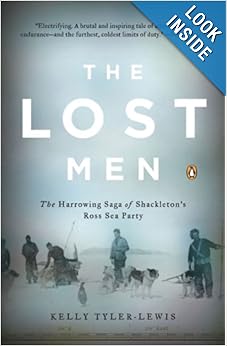 Only in 2006 was the first complete history of The Harrowing Saga of Shackleton’s Ross Sea Party told. Kelly Tyler-Lewis’ The Lost Men draws from diaries and the very few previously published notes and told the rest of the story.
The dust jacket summarizes the events as follows:
In 1914, Sir Ernest Shackleton sailed south aboard the Endurance to be the first to cross Antarctica from coast to coast. Shackleton’s endeavor is legend, but few know the astonishing story of the Ross Sea party, the support crew he dispatched to the opposite side of the continent on the Aurora to build a lifeline of food and fuel depots to sustain his crossing.
“I had not anticipated that the work would present any great difficulties,” Shackleton wrote. But the Aurora broke free of her moorings and disappeared in a gale in 1915, stranding ten men on the continent with only the clothes on their backs and a few provisions. With little hope of rescue from civilization, then embroiled in World War I, the men decided to go forward with their mission. Against all odds, the Ross Sea party trekked across the Ross Ice Shelf to cache Shackleton’s provisions, sledging 1,700 miles with scavenged gear. They never imagined that their
immense sacrifice was…futile.
…by the end of 1915, the Endurance lay crushed at the bottom of the Weddell Sea. Shackleton (had) never set foot on the continent. Marooned for two years, some of the Ross Sea party would lose their lives before the ordeal was over.
~~~~~~~~~~~~~~~~~~~~~~~~~~~~~
This MBOB was just going to be about the glories of a genuine January thaw – then last night I got acquainted with the book about Shackleton’s other group and realized that those men fought to save themselves from a far more organized predicament but with not much more equipment than was possessed by the couple who went driving out east of town.
Anyone who has read of Shackleton’s work to save his men from Elephant Island and who may now read of this less well-known group fighting for their own lives 1700 miles away on the other side of Antarctica, won’t easily speak ill of them. They fought to live.
